Packs & Authoring SDK
One SDK, one lifecycle — author Integrations, Ontologies, Workflows, Process Flows, and Data Sources and ship them as upload-ready bundles
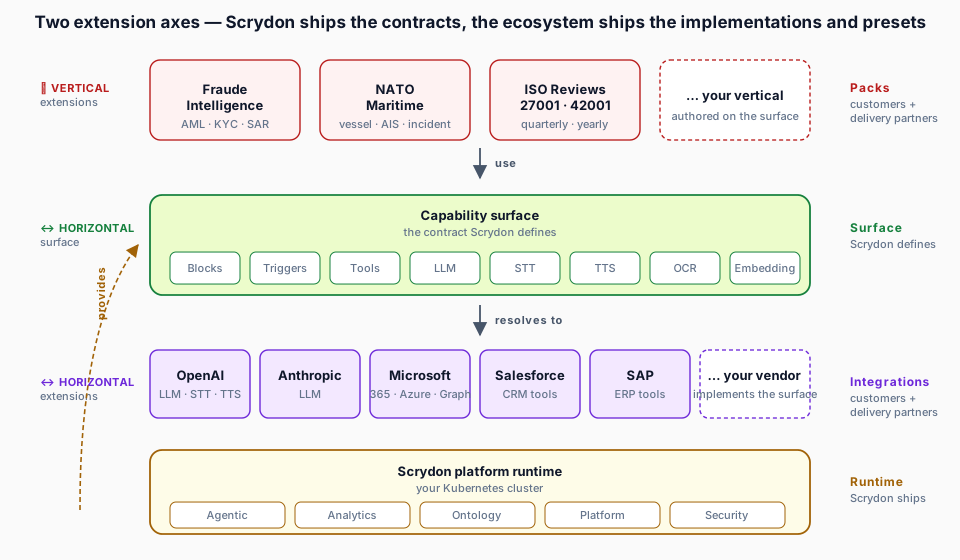
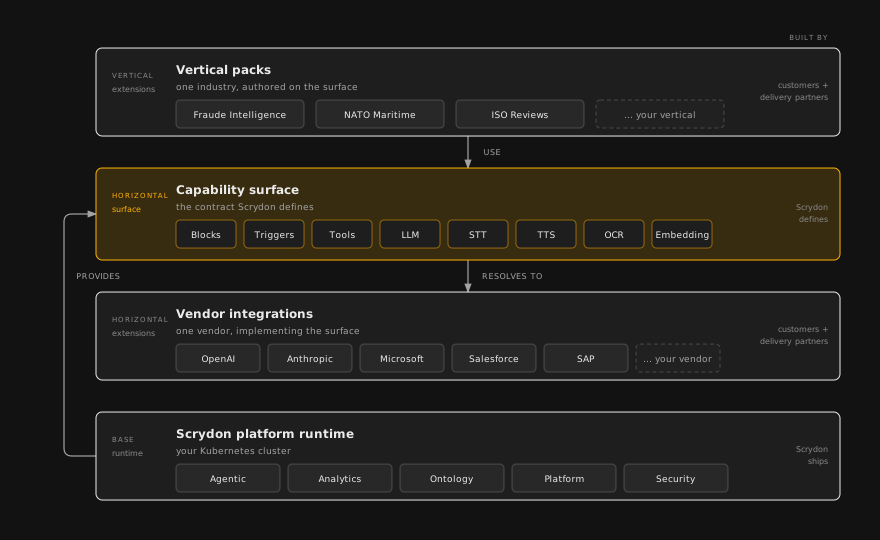
@scrydon/sdk-authoring is the single SDK for authoring platform extensions. It has five subpath surfaces — one per artifact you can ship:
Integrations
Vendor connectors with auth, blocks, tools, and capability runtimes (LLM, STT, TTS, embeddings, OCR, video, webhooks).
Ontologies
Typed Object Types, Link Types, Action Types, identity rules, and bindings shipped as a versioned pack.
Workflows
Executable block-graph workflows (HITL gates, approvals, automations) that ship inside a Pack alongside a Process Flow.
Process Flows
Reusable process flows with stages, tasks, personas, voice triggers, and action templates.
Data Sources
Declarative poll data sources — REST request spec, bounded field-mapping DSL, and typed column list — shipped as pure JSON in a Pack.
Pack vs Integration
There are two top-level bundle types you upload to Scrydon. Pick by what you are modelling:
- Integration — a vendor capability bundle. Compiled ESM + manifest + SBOM, runs sandboxed inside the platform. Use it to connect Scrydon to an external service (Slack, OpenAI, Twilio) and expose capabilities — LLM, STT, TTS, embeddings, OCR, video, webhooks, blocks, and tools. Authored with
defineVendor, built withbunx @scrydon/sdk-authoring integrations build. - Pack — a domain content bundle. Groups an Ontology (typed Object Types, Link Types, Action Types), zero or more Workflows (HITL gates, approval routes, automations), a Process Flow (stages, tasks, personas, action templates), zero or more Data Sources (declarative poll sources — REST request, field-mapping DSL, typed column list), and zero or more custom integrations into one upload-ready archive. A pack
contents[]array may mixontology,workflow,process-flow,data-source, andintegrationkinds. Use it to ship a domain model together with its standard playbook, data feeds, and any custom vendor integrations it depends on. Authored withdefineScrydonPack, built withbunx @scrydon/sdk-authoring pack build.
In short: Integrations bring capability into the platform; Packs bring domain content — and can bundle custom integrations alongside it. Both upload through Settings → Platform → Bundles.
Install
bun add -d @scrydon/sdk-authoring zodnpm install --save-dev @scrydon/sdk-authoring zodConfirm the install resolved correctly:
bunx @scrydon/sdk-authoring --versionHow authoring works
Every artifact uses the same shape:
Compose your artifact with define*() helpers. They are identity functions at runtime — their job is to narrow types so your IDE catches mistakes before you build.
A Zod manifest schema (ManifestSchema, OntologyManifestSchema, ProcessFlowManifestSchema) validates the artifact at build time and again on the server at upload time.
Run the corresponding CLI to produce an upload-ready .tar.gz. Integration bundles contain compiled ESM + a CycloneDX SBOM; ontology and process-flow bundles are pure JSON.
Upload through Settings → Platform → Bundles (or the matching admin API). The platform validates the manifest, persists the bundle, and registers it in the catalog. No redeploy required.
CLI
@scrydon/sdk-authoring ships a single bin with two subcommands. Invoke it via the package-qualified form — it works whether or not the package is installed locally:
| Subcommand | Authors | Commands |
|---|---|---|
@scrydon/sdk-authoring integrations | Vendor integration bundles | init, build, test |
@scrydon/sdk-authoring pack | Scrydon Pack bundles (ontology + workflows + process flow + data sources + integrations) | build, inspect, validate |
Ontology packs ship as a subdir of the Scrydon Pack bundle. Standalone ontology bundles use the same defineOntology SDK with no CLI needed (they're embedded in pack bundles or shipped via npm).
bunx @scrydon/sdk-authoring --version
bunx @scrydon/sdk-authoring --help
bunx @scrydon/sdk-authoring integrations --help
bunx @scrydon/sdk-authoring pack --help
bunx @scrydon/sdk-authoring integrations build --entry src/index.ts
# pack build accepts a directory — it auto-discovers pack.ts | pack.mjs | pack.js | pack.json,
# then derives a source directory for EVERY declared `contents[]` entry at
# <baseDir>/<entry.path>. That covers all content kinds — ontology, workflow,
# process-flow, data-source, and integration — so a pack mixing kinds builds
# with no per-kind flags.
bunx @scrydon/sdk-authoring pack build .
bunx @scrydon/sdk-authoring pack build ./my-pack
# `--ontology` / `--process-flow` remain as optional overrides for those two
# kinds' subdir locations; every other kind is taken from contents[].path.
bunx @scrydon/sdk-authoring pack build pack.json --ontology ./ontology --process-flow ./process-flowValidate a built pack — the platform sync gate, locally
pack validate pointed at a built pack directory (one whose manifest is a
pack.json — e.g. dist/<pack> in a Git pack source repository) runs the
full platform sync gate locally: file and extension rules, declared-subdir
layout, the pack.json schema, and every per-kind manifest.json schema.
The rules and error messages are the exact ones the platform's bundle
inspector applies on every sync, so a pack that passes here cannot fail
sync-time validation — an invalid contents[].kind or a stray undeclared
directory fails your PR instead of the next sync.
# Full sync-gate validation of a built pack directory.
# Git pack sources: run this on every dist/<pack> in CI.
bunx @scrydon/sdk-authoring pack validate ./dist/my-pack
# Manifest-only validation (source manifests: pack.ts | pack.mjs | pack.json)
bunx @scrydon/sdk-authoring pack validate ./my-pack/pack.ts
bunx @scrydon/sdk-authoring pack validate ./my-pack --manifest-onlypack build runs the same manifest + per-kind schema validation while
bundling, so tarball-based flows get identical guarantees at build time.
Build a Git pack source — pack build-dist
Git pack sources commit built dist/<pack>/ directories that the
platform tars and inspects on every sync. pack build-dist owns that whole
src→dist transform, so a pack repository needs no hand-rolled build script:
# src/<pack> → dist/<pack>: compiles pack.ts / manifest.ts (manifestVersion
# injected for ontology + workflow DSL inputs), builds integration sources
# deterministically (stable SBOM + byte-stable bundle.tar.gz), skips
# _-prefixed authoring dirs, copies assets — then runs the full sync gate
# on the result.
bunx @scrydon/sdk-authoring pack build-dist src/my-pack --outDir dist/my-packContent kinds come from the manifest's contents[] — never from directory
naming. Rebuilding an unchanged pack produces byte-identical output, so
committed dist/ never drifts across machines.
For a whole pack-source repository, pack build-source is the only build
command you need — no build script at all:
# Builds every src/<pack> → dist/<pack> via build-dist, then checks
# scrydon.yaml entry versions against the built artifacts (a mismatch is
# what the platform rejects as version_mismatch at sync time).
bunx @scrydon/sdk-authoring pack build-source . --check-catalog
# --waive downgrades a named pack's failure to a loud warning — for content
# deliberately ahead of platform support (e.g. a content kind the platform
# has not shipped yet). Everything else still fails the build.
bunx @scrydon/sdk-authoring pack build-source . --check-catalog --waive my-experimental-packBundle formats
| Artifact | Archive | Code? | Validated by |
|---|---|---|---|
| Integration | <vendorId>-<version>.bundle.tar.gz | Compiled ESM + manifest + SBOM | ManifestSchema (Zod), CycloneDX inspector, native-dep guard |
| Scrydon Pack | <package.id>-<package.version>.scrydon-pack.tar.gz (ontology + zero-or-more workflow subdirs + process-flow + zero-or-more data-source subdirs) | None — pure JSON | PackBundleManifestSchema, ProcessFlowManifestSchema, OntologyManifestSchema, WorkflowManifestSchema, DataSourceManifestSchema, DAG cycle validator |
Integration bundles run sandboxed in a Worker Thread with a Node-module blocklist; process flows and ontology packs are data-only and never execute caller-supplied code.
Build your first Pack
The fastest way to learn the surface is to ship one Pack end-to-end. Each step links the full per-artifact guide:
Define Object Types, Link Types, Action Types, and identity rules. → Authoring: Ontologies
HITL gates, approval routes, automations the flow's actions will invoke by slug. → Authoring: Workflows
Stages, task templates, personas, action templates, voice triggers. → Authoring: Process Flows
Declarative poll sources: REST request spec, field-mapping DSL, typed columns. → Authoring: Data Sources
bunx @scrydon/sdk-authoring pack build ./my-packProduces <package.id>-<package.version>.scrydon-pack.tar.gz — pure JSON, validated by the manifest schemas and the DAG cycle validator.
Settings → Platform → Bundles (or the admin API). One atomic install: ontology, workflows, process flow, data sources.
Where to next
Build a custom Integration
Vendor connectors — defineVendor, capabilities, blocks, tools, and the build / upload loop.
Author an Ontology pack
Define Object Types, Link Types, Action Types, identity rules, and bindings.
Author a Workflow
HITL gates, approval routes, and automations referenced from Process Flows by slug.
Ship a Process Flow
Stages, task templates, personas, action templates, and voice triggers.
Author a Data Source
Declarative poll data sources — REST request, bounded mapping DSL, and typed columns — shipped as pure JSON in a Pack.